
Accounting Problems in Bangladesh Businesses:
What Causes Them and What Actually Works
Ask ten business owners in Dhaka or Chattogram what keeps their accounting broken and you will hear the same handful of answers: the books are behind, the VAT deadline arrived before the paperwork did, nobody is sure what the real profit is, and the one person who understands the numbers is unavailable. These are not personal failings. They are the predictable accounting problems in Bangladesh businesses — and each one has an identifiable cause and a workable solution. This guide walks through all six, what actually causes them, and the honest comparison between fixing them in-house, hiring, and outsourcing.
The Three Solutions — and What Each Really Costs
- Fix it in-house: Better software plus firmer routine works when volume is genuinely small and someone capable actually owns the task. Its hidden cost is the owner’s or a staff member’s hours at their real value — and its failure mode is the backlog quietly returning the first busy month. Worth attempting first at very low volume; worth abandoning honestly when it slips twice.
- Hire an accountant: A full-time hire brings dedicated attention and makes sense once daily transaction flow genuinely fills the seat. Count the full cost — salary, benefits, training, software, leave cover — and note that a single hire recreates problem five: one person, one point of failure. For what the numbers should look like before you commit, see how much accounting should cost a small business.
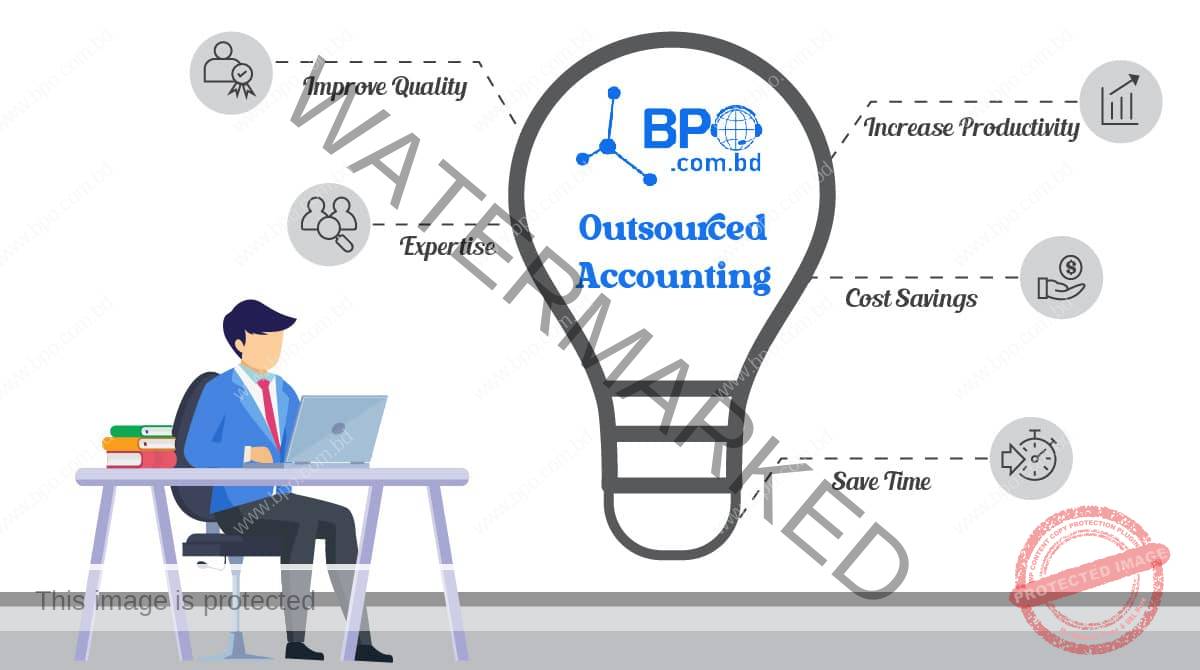
- Outsource the function: Outsourced accounting puts a professional team behind the books at a variable cost that scales with volume. It resolves the skills problem (specialists, not generalists), the continuity problem (a team, not a person), and the discipline problem (contractual deadlines rather than good intentions). The scope can stay narrow — bookkeeping only — or extend into full financial management services; if you are unsure where to start, begin with accounting or bookkeeping: which to outsource first, and weigh whether professional bookkeeping is worth the cost for your volume.
Set expectations honestly for the first quarter of any outsourced engagement: the opening weeks go to catch-up and reconciliation of the backlog, the first full month produces the first reliable report pack, and by the end of the quarter the rhythm — books current, accounts reconciled, filings prepared from live records — should feel routine. A provider unwilling to commit to that shape of timeline in writing is telling you how the engagement will actually run.
Six Accounting Problems Bangladesh Businesses Face Most
Problem → Cause → Solution: The Map
| Problem | Root cause | Solution and services that fix it |
| Books weeks behind | No owned routine; owner time scarce | Outsourced bookkeeping with turnaround SLAs |
| Cash records hide profit | Cash-basis habit; no accrual view | Proper ledgers + monthly management reports |
| Rushed VAT/tax filings | Incomplete records at deadline | Continuous books + NBR/VAT-fluent compliance support |
| Unreconciled accounts | Tedium; no accountability | Scheduled reconciliation with exception reporting |
| One-person finance risk | Cost of a full team | Provider team with named account manager |
| Stale reports | No reporting calendar | Fixed monthly reporting with payroll processing and close deadlines |
1. Books that are weeks or months behind
The most common problem is the simplest: transactions happen daily, recording happens “when there’s time,” and there is never time. Backlogged books turn every later task — filing, borrowing, deciding — into an archaeology project. Professional bookkeeping services exist mostly to make this one problem permanently disappear.
2. Cash-basis records that hide real profit
Many businesses track cash in and cash out and call it accounting. Cash movement is not profit: unbilled work, unpaid supplier invoices, and inventory sitting on shelves are all invisible to a cash notebook. Owners routinely discover they were less profitable — or more — than they believed, months after the decisions that depended on knowing.
3. VAT and tax filings done under pressure
Filing obligations under the VAT and Supplementary Duty Act 2012 and income tax requirements with the National Board of Revenue (NBR) arrive on a fixed calendar. When the underlying records are incomplete, filings become rushed reconstructions — and rushed reconstructions invite errors, penalties, and audit attention. The filing is rarely the problem; the missing months behind it are.
4. Unreconciled accounts — and the leakage they hide
If bank statements, mobile-money accounts, and the ledger are never matched line by line, small leaks stay invisible: duplicate payments, unbilled deliveries, quiet discrepancies. Reconciliation is tedious, which is exactly why it gets skipped, and exactly why skipping it is expensive.
5. Finance knowledge locked in one person’s head
Whether it is the owner or a single trusted accountant, one-person finance is one resignation, illness, or holiday away from standstill. It also means no second pair of eyes — the basic control that catches both honest error and dishonest ones.
6. Reports too old to act on
A profit figure from four months ago is history, not information. Businesses running on stale reports make current decisions with outdated numbers — pricing that no longer covers costs, credit extended to customers who stopped paying, stock reordered against demand that moved.
What Causes These Problems
The causes are structural, not moral. Qualified accounting staff are expensive relative to what a small or mid-sized business can justify, so the work lands on whoever is nearest. Founders’ attention goes where revenue is, and recording yesterday’s transactions never feels urgent until a deadline makes it an emergency. Manual, paper-and-spreadsheet processes multiply effort and error. And Bangladesh’s compliance stack — NBR requirements, VAT filings, Companies Act 1994 records, RJSC obligations — demands specific fluency that generalist staff rarely hold. Put simply: the work requires professional discipline that most growing businesses cannot economically employ full-time. That mismatch, not carelessness, is the root cause.
One cause deserves its own sentence because it wastes the most money: the belief that software alone fixes accounting. Software records what a disciplined person feeds it; it does not chase the missing receipts, reconcile the accounts nobody opened, or notice the supplier who billed twice. Businesses that bought a subscription and kept the same habits end up with the same six problems — now with a monthly software invoice attached.
When Outsourcing Is Not the Answer
Consistency demands the counter-case. Outsourcing is the wrong buy when the business is pre-revenue with a dozen transactions a month; when a capable in-house arrangement already delivers timely, reconciled reporting and the itch is fashion rather than measured pain; or when the real problem is upstream — no sales — and cleaner books would merely document the decline more accurately. It also fails when bought carelessly: a provider without written service levels or Bangladesh compliance fluency relocates your problems without solving them. The next section is the filter.
Choosing an Accounting Partner in Bangladesh
Six checks separate a partner from a vendor: demonstrated NBR, VAT, and Companies Act fluency (ask them to walk through your filing calendar); written SLAs for turnaround and accuracy; a named accountable person plus a team behind them; a reporting calendar you see before signing; data security terms in writing — access control and storage location; and clean exit terms returning your ledgers and documents if you leave. Any hesitation on the six is your answer. When you want the conversation, contact us.
FAQ
1 What are the most common accounting problems in Bangladesh businesses?
Six recur constantly: books maintained weeks late, cash-basis records that misstate profit, VAT and tax filings prepared under deadline pressure, unreconciled bank and mobile-money accounts, finance knowledge concentrated in one person, and management reports too old to guide decisions.
2 What causes these accounting problems?
Structure, not carelessness: professional accounting skill is costly to employ full-time, founder attention goes to revenue, manual processes multiply errors, and Bangladesh's compliance requirements — NBR, VAT, Companies Act, RJSC — demand specific fluency that generalist staff rarely hold.
3 What is accounting process outsourcing?
Contracting an external professional team to run defined accounting functions — bookkeeping, reconciliation, payables and receivables, payroll, reporting, compliance support — under agreed service levels, instead of staffing them internally.
4 Does outsourcing accounting actually improve profit?
Indirectly but reliably: through recovered owner hours, avoided penalties and leakage, and decisions made on current numbers. The honest measure is your fully loaded internal cost versus the fee, plus the value of errors that stop happening. Set baseline metrics before starting so the effect is provable.
5 When should a business outsource instead of hiring an accountant?
When transaction volume needs professional discipline but cannot yet fill a full-time senior seat; when continuity matters (a team survives resignations, one hire does not); or when compliance fluency is the gap. Many businesses outsource first and hire later — onto clean books.