
Medical Billing and Patient Collection Services from Bangladesh
The payer’s share is a claim. The patient’s share is a phone call, and US law is listening to it.
Once insurance has paid, what is left sits with the patient, and most practices have nobody whose actual job is to collect it. The work is not hard. What makes it risky is that the moment an account is treated as a debt in default, or an outsourced team starts using a name of its own, a different federal statute attaches. We run patient balances as first-party billing support, in your name, under your policy, and we will tell you exactly where that line sits.
A patient balance, by age
- Current
- 30
- 60
- 90
- 120+
Somewhere along this strip the account becomes “in default”. That point is set by your patient agreement and your policy, not by the calendar, and it is the single fact that decides which law governs the next call.
Most practices cannot say where their own line is. That is the first thing we ask for, and the first thing we put in writing.
Getting The Payer To Pay Is A Different Job From Getting The Patient To Pay
They use the same software and they are usually bought from the same vendor, which is why they get confused. They are not the same work and they do not carry the same risk.
This page
The patient’s share
Deductibles, co-insurance and self-pay balances. Statements, payment plans, pre-service estimates and the calls that follow. A human conversation about money, governed by consumer protection law.
Different page
The payer’s share
Coding, claim scrubbing, submission, denials, appeals and AR follow-up with insurers. A rules engine problem, governed by payer contracts. That is covered on healthcare BPO and medical billing.
Four Places A Patient Balance Quietly Dies
None of these is a billing error. Each one is a conversation that nobody had, usually because the front desk was busy and the balance was small enough to ignore.
Before the visit
Nobody told the patient what the visit would cost them. Benefits were checked for the payer’s benefit, not the patient’s.
A surprise balance is the hardest kind to collect.
At the desk
The co-pay was not asked for at check-in, because the queue was long and asking is awkward.
Money in the room is worth several times the same money on a statement.
The first statement
It arrives listing codes and adjustments, so the patient cannot tell what they are being asked to pay for, and puts it aside.
A bill nobody understands is a bill nobody pays.
After 90 days
Nobody has called. The account drifts toward write-off or gets handed to an agency for a fraction of its value.
This is also the point where the legal position changes.
Billing Support And Debt Collection Are Separated By Facts, Not By Job Titles
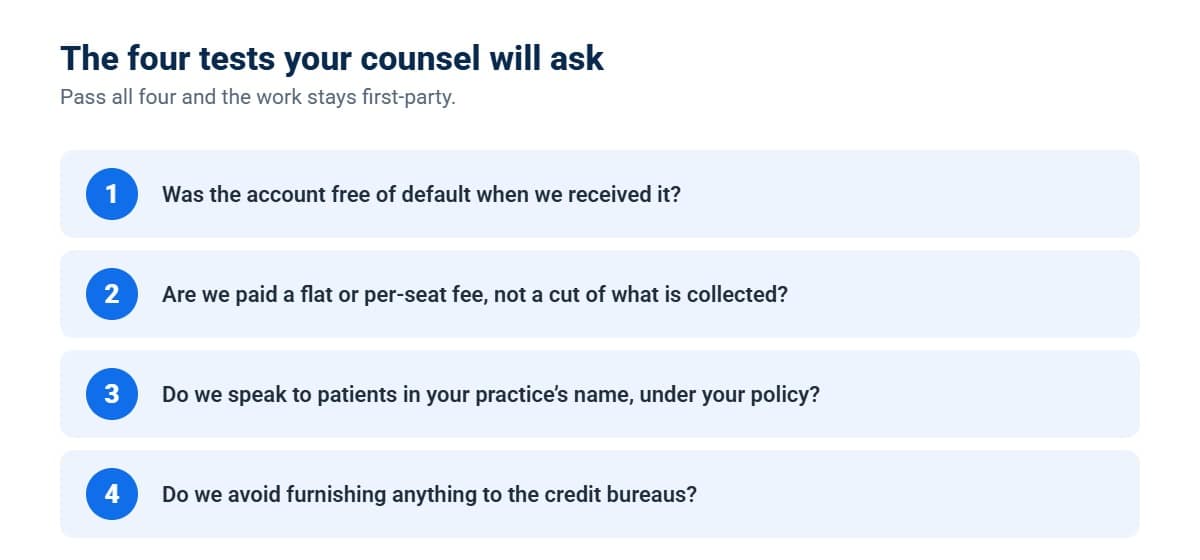
This is not legal advice and we are not your lawyers. It is the set of questions your counsel will ask, and you should know the answers before an offshore team starts calling your patients.
Test one · was it in default?
Whether the account was already in default when it reached us
Under the Fair Debt Collection Practices Act, liability attaches to a “debt collector”, and a servicer that receives an account before it is in default generally falls outside that definition. In Ward v. NPAS, a hospital’s extended business office was held not to be a debt collector precisely because the accounts were not in default when transferred to it; the Sixth Circuit affirmed that in March 2023. The FTC’s position is the mirror image: where the debt was in default when the company obtained it, collection activity is covered.
Test two · whose name is on the call?
Using a separate name can create the exposure by itself
The FTC has made the point plainly: if a creditor collects its own debts but uses a different name that suggests a third-party collector, it becomes a debt collector subject to the Act. This is the trap an offshore vendor walks a practice into without meaning to. We identify ourselves as working for your practice, on your letterhead, under your policy. We do not invent a collections brand.
Test three · which state?
State definitions are wider than the federal one
Practitioners warn that federal and state definitions of debt collector are often broader than companies realise, that medical billing companies may meet the federal definition depending on how they actually operate, and that some states, California among them, reach further still. Your patient mix decides which states you are exposed in, so the scope conversation starts with where your patients live.
Test four · how are you calling?
The telephone rules apply whichever side of the line you are on
Counsel advising providers put the Telephone Consumer Protection Act alongside the FDCPA as the two federal regimes carrying the most risk in medical collections. Consent, calling methods and calling hours are your rules to set; we follow the script and the contact window your practice signs off, and we log every attempt so you can prove what happened.
What We Take On And What We Will Not Touch
The right column is not modesty. Those are the activities that would change our legal character and yours, and no offshore pricing advantage is worth that.
We do this
- Pre-service estimates, so the patient knows the number before the appointment
- Rewriting statements into plain language a patient can act on
- Courtesy balance calls on current accounts, in your practice’s name
- Setting up and monitoring payment plans against the terms you approve
- Posting patient payments and reconciling the patient AR
- Flagging accounts for your financial assistance or charity policy
- Preparing the handover file when you do send an account to an agency
We do not do this
- Act as a third-party collection agency on accounts already in default
- Buy debt, or take a contingency cut of what is recovered
- Trade under a collections name of our own invention
- Furnish anything to a credit bureau on your behalf
- Threaten legal action, credit damage or any consequence
- Discuss a balance with anyone who is not the patient or their authorised representative
- Start any patient contact before a business associate agreement is signed
Key Facts On Medical Debt And Credit Reporting
The rules here changed twice in two years and a lot of published advice is now wrong. This is where the position stands, with the sources.
- There is no federal ban on medical debt appearing in credit reports. The CFPB finalised a rule in January 2025 that would have removed roughly $49 billion in medical debt from the reports of about 15 million people. A federal court in the Eastern District of Texas vacated it on 11 July 2025, holding that the Bureau exceeded its authority under the Fair Credit Reporting Act.
- The credit bureaus’ own policy still applies. Since 11 April 2023 Equifax, Experian and TransUnion have removed paid medical collections from credit reports and stopped reporting medical collections with an initial balance under $500. That is a voluntary industry policy, not law, which matters when you are deciding what to tell a patient.
- State law is now the real variable. As of early 2026 around 15 states have passed their own restrictions on medical debt credit reporting, so the correct answer to a patient’s question depends on where that patient lives.
- A balance sitting with the provider is not a collection tradeline. Keeping an account in first-party billing, worked properly, is the cheapest patient-protection measure a practice has, and it is the whole argument for staffing this work instead of outsourcing it to an agency.
- Who we are. BPO Bangladesh has delivered outsourced operations from Dhaka since 2008, with a US client relationship running since 2009. Dhaka is UTC+6 with no daylight saving, which puts our working day across the American night.
- No patient contact without a BAA. A company handling protected health information for a provider is a business associate under HIPAA, and the agreement is signed before any access is granted.
Sources: Consumer Financial Protection Bureau, medical debt credit reporting rule (January 2025) and the July 2025 order vacating it · Equifax, Experian and TransUnion joint medical debt reporting policy, effective April 2023 · Ward v. NPAS, Inc., Sixth Circuit, March 2023, on when a billing servicer is not a debt collector · Fair Debt Collection Practices Act, on first-party creditors using a different collecting name · US Department of Health and Human Services, HIPAA business associate guidance. Positions stated here are general and are not legal advice; confirm them with your own counsel for your states.
Where This Connects
Patient collections rarely arrives on its own. Most practices that call us about it also have a claims backlog behind it.
Reviewed by Sabina Yeasmin, Head of Operations, BPO Bangladesh. Last updated November 2026.
Patient Billing And Collections: Straight Answers
What is the difference between medical billing and medical collections?
Medical billing produces and submits the claim and chases the insurer. Medical collections is the work of recovering what the patient personally owes after the insurer has paid: deductibles, co-insurance, co-pays and self-pay balances. The first is governed by payer contracts; the second is governed by consumer protection law, which is why the two should be staffed and scripted differently.
Does hiring an offshore team make us subject to the FDCPA?
Not by itself, and this is a question for your counsel rather than for us. The FDCPA attaches to a “debt collector”, and courts have held that a servicer receiving accounts that are not in default is generally outside that definition. Two things commonly change the answer: taking accounts that were already in default, and using a separate collecting name. We avoid both by design, and we put the arrangement in the contract so your counsel can see it.
Can medical debt still go on a patient’s credit report?
Yes, with limits. The CFPB rule that would have banned it was vacated by a federal court in July 2025, so there is no federal prohibition. The three nationwide bureaus still apply their own April 2023 policy of excluding paid medical collections and collections under $500, and around 15 states have added their own restrictions. The accurate answer for any individual patient depends on their state and the balance, which is exactly why staff should not improvise an answer on a call.
Will patients know they are speaking to an offshore team?
We call in your practice’s name because that is what keeps the engagement first-party, and we never claim to be a collection agency. If a patient asks directly where the team is based, we answer honestly. Pretending otherwise is both dishonest and, given how the different-name rule works, the opposite of safe.
How quickly can you start?
Set-up has historically taken about three to seven working days for a single-physician practice once the contract and the business associate agreement are signed, assuming system access is granted promptly. A multi-site group or a hospital takes longer, mostly because approving the call script and the contact policy takes longer than the technical set-up does.
Do you work in our practice management system?
Yes. We work inside the system you already use, through named accounts with the access level you grant, rather than exporting patient data to our own tools. Nothing is copied to local machines. If your system cannot support named offshore accounts with an audit trail, say so early, because it changes what we can offer.
How is this priced?
Per full-time equivalent per month, or per account worked. Deliberately not on a percentage of what is recovered: a contingency fee gives the people making the calls a personal stake in pressing harder, which is precisely the incentive you do not want on a patient balance conversation. Billing is in US dollars, excluding VAT.
What happens to accounts you cannot resolve?
They come back to you with a documented contact history, the patient’s stated reason, and a recommendation: financial assistance, a longer payment plan, a write-off, or referral to an agency. The decision to place an account with a collection agency is yours and stays yours. We prepare the file; we do not make that call and we do not take a share of what an agency later recovers.
First-Party Servicer Vs Third-Party Collector
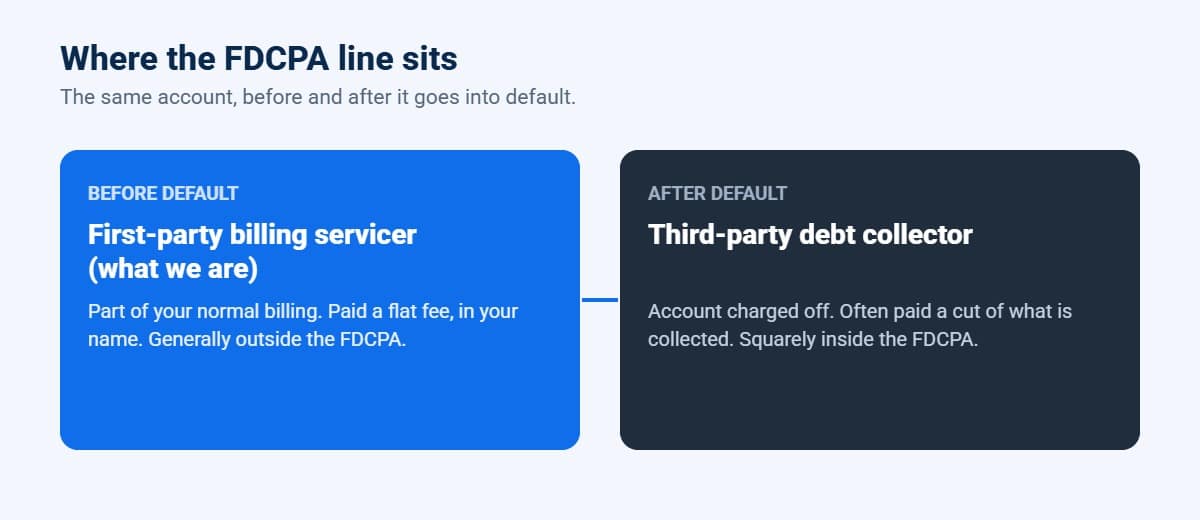
| First-party billing servicer (what we are) | Third-party debt collector | |
|---|---|---|
| When the account arrives | Before default, as part of normal billing | After default or charge-off |
| How it is paid | A flat or per-seat fee, not a cut of what is collected | Often a percentage of what is collected |
| FDCPA status | Generally outside it (Ward v. NPAS, 6th Cir. 2023) | Squarely inside it |
| Credit-bureau furnishing | We do not furnish | May furnish |
| Who owns the account | Stays the practice’s | May be bought |
Patient Collections: Key Facts
- Track record
- Since 2017, BPO Bangladesh has run patient billing and collections for 45 US medical practices.
- What this is
- First-party patient billing support run from Dhaka for US practices: pre-service estimates, plain-language statements, balance calls in your name and under your policy, and payment plans. It is not third-party debt collection.
- The FDCPA line
- FDCPA liability attaches only to a “debt collector”. A servicer that receives accounts before they are in default generally falls outside that definition — the position the Sixth Circuit took in Ward v. NPAS, Inc. (March 2023).
- Credit reporting now
- The CFPB’s January 2025 rule to strip medical debt from credit reports was vacated by a federal court on 11 July 2025, so there is no federal ban. Most published advice written before that date is now wrong.
- Bureau policy
- Since 11 April 2023 Equifax, Experian and TransUnion have removed paid medical collections and those with an initial balance under $500 — about 70% of medical-collection tradelines.
- Scale
- The CFPB reported that around 15 million people carry roughly $49 billion in medical debt on their credit reports.
- What we do not do
- No contingency pricing, no debt buying, no credit-bureau furnishing, no separate collections brand, and no accounts that are already in default — the five limits that keep this work first-party.
Send Us Your Patient AR Ageing, With The Names Removed
Balances by age bucket and count, no patient identifiers, nothing that needs an agreement in place to look at. We will come back with what we think is realistically collectable, what should go to financial assistance, what looks like a statement problem rather than a payment problem, and where your in-default line appears to sit today. Please do not send patient information through the website form.